YOUR INJURIES WERE REAL.

THE PROBLEM WASN'T THE INJURY.
IT WAS THE EXPLANATION.

Sometimes the greatest barrier to recovery isn’t proving you were injured.

It’s helping others understand exactly what those injuries mean.

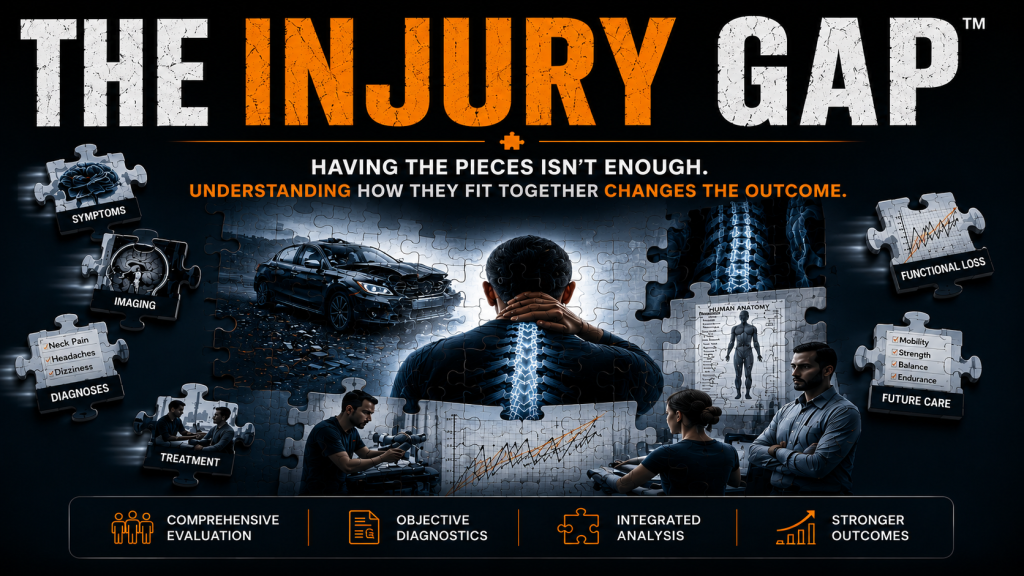
The Injury Gap™ explores why objective findings sometimes fail to become objective understanding—and why understanding changes outcomes.

Why do good injury cases still
produce disappointing outcomes?

The Missing Piece Isn't Always Another Test. Sometimes It's Understanding.

Most people assume that if enough tests are performed, the truth becomes obvious.

Unfortunately, that’s not how injury cases work.

Symptoms…
Imaging…
Medical records…
Specialist reports…

These pieces often exist—but they don’t always tell a clear story.

Without a clear medical explanation, legitimate injuries are easily misunderstood, undervalued, or overlooked.

That’s why having evidence isn’t enough. Someone has to connect the dots.
Understanding begins when every piece is connected.

Why It Matters

Because evidence without explanation is often overlooked.

Objective Evidence Exists

Injuries often leave measurable findings through advanced imaging, functional testing, biomechanics, neurological evaluation, and specialist examinations.

Why It Matters

But the Pieces Stay Disconnected

Objective Evidence Exists

Each provider may document one part of the injury, yet no one connects those findings into a complete medical explanation.

Why It Matters

Understanding Drives Decisions

Objective Evidence Exists

Insurance companies, attorneys, physicians, and juries evaluate whether the injury has been clearly explained and medically supported.

Why It Matters

Clear Explanation Changes Outcomes

Objective Evidence Exists

When objective findings are connected into one evidence-based story, treatment decisions improve and injuries are more accurately understood and valued.

The Injury Gap™ is the space between 

having objective evidence 

and creating objective understanding.

Modern diagnostics can reveal remarkable information. MRI findings, functional testing, biomechanics, neurological evaluation, specialist opinions, and clinical history all contribute valuable pieces.

But no single test explains an injury by itself.

Understanding happens when those pieces are connected into one coherent story.

Comprehensive Evaluation

Every case begins with collecting every meaningful piece of objective evidence.

Objective Diagnostics

Advanced imaging and functional testing provide objective evidence beyond symptoms alone. 

Integrated Analysis

Every finding is connected into one clear, evidence-based explanation.

Stronger Outcomes

Better understanding leads to better clinical decisions, stronger negotiations, and improved outcomes.

Scroll to Top