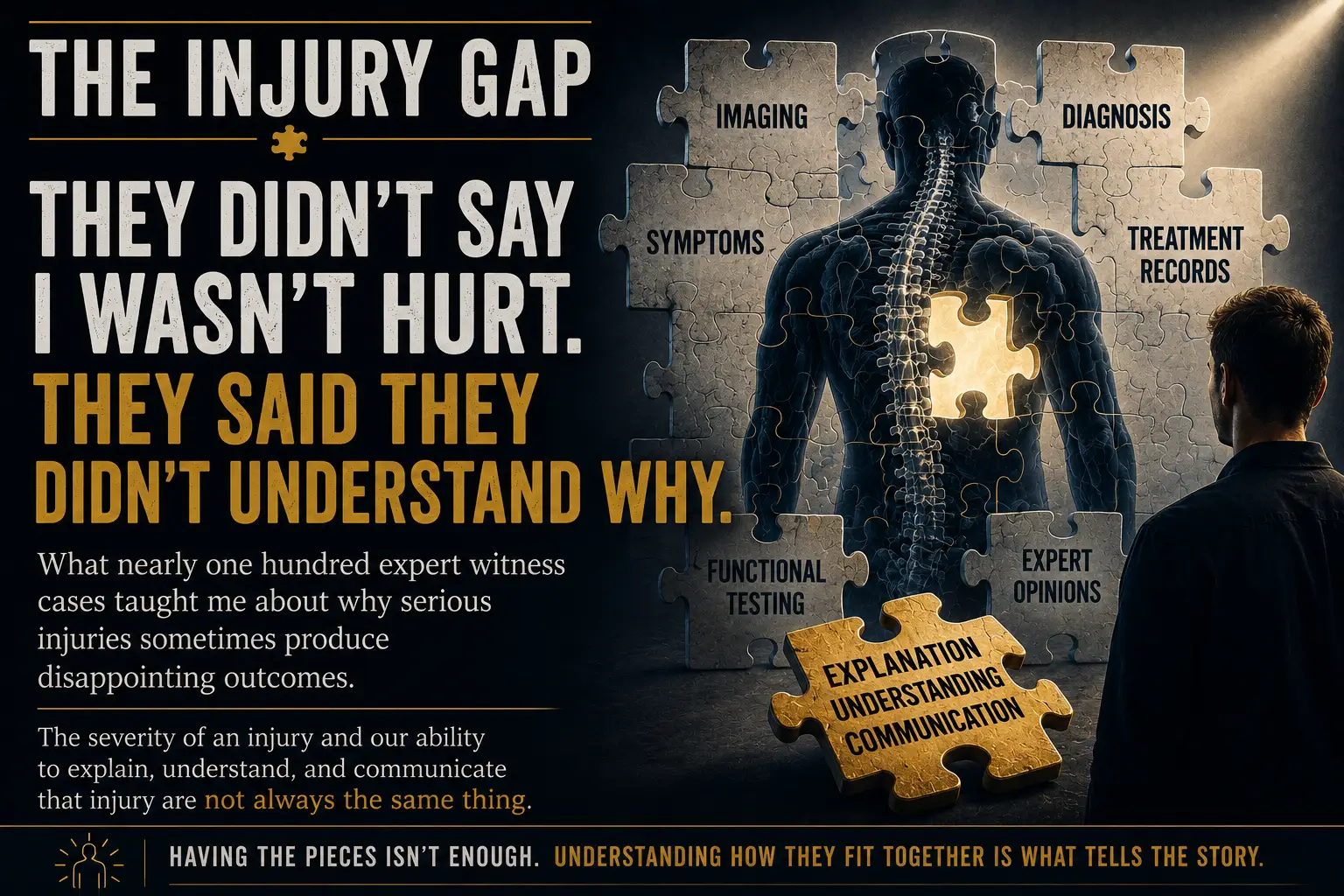
What nearly one hundred expert witness cases taught me about why serious injuries sometimes produce disappointing outcomes.
One of the advantages of serving as an expert witness is that I already know how the story ends before I ever open the first medical record. By the time an attorney asks me to review a case, the patient has usually spent years living with the consequences of a motor vehicle collision. They've seen multiple physicians, undergone imaging, completed months of treatment, and often endured injections, surgery, or pain management.
By the time I become involved, settlement discussions have stalled, trial is approaching, or someone is trying to understand why a case that once seemed so strong has become so difficult.
When I first began reviewing these cases, I assumed I would spend most of my time discovering injuries that had been missed. I expected to find the MRI that should have been ordered, the specialist who should have been consulted, or the diagnosis that had somehow slipped through the cracks. Those situations certainly exist, but they weren't what surprised me the most.
Instead, I kept encountering something much more unsettling. The injuries were often documented. The imaging had been performed. Specialists had evaluated the patient. Every provider had contributed valuable information.Yet after reading hundreds of pages of medical records, I found myself asking one simple question.
What actually happened to this person?
That question changed the way I think about injury forever. It wasn't that the records lacked information. Quite the opposite. They contained emergency room reports, MRI studies, X-rays, specialist consultations, operative reports, therapy records, and functional testing. Every piece had value, but every piece stood on its own.
The emergency physician documented the trauma. The radiologist interpreted the imaging. The orthopedic surgeon focused on one part of the body, while the neurologist focused on another. Each provider understandably viewed the patient through the lens of their own specialty. No one had done anything wrong. But no one had connected the story.
The Evidence Was There. The Story Wasn't.
Like most people, I once believed that serious injuries naturally produced serious outcomes. It seemed logical. The more severe the injury, the easier it should be for everyone to recognize its significance. I assumed the medical evidence would speak for itself.
After reviewing nearly one hundred expert witness cases, I've learned that it often doesn't. The severity of an injury and our ability to understand that injury are not always the same thing. Some injuries are obvious. Others permanently change a person's life while remaining surprisingly difficult for medicine, the legal system, employers, family members, and even friends to fully appreciate.
That realization eventually led me to something I now call The Injury Gap™.
What Is The Injury Gap™?
The Injury Gap™ is the space between the injury a person actually sustains and the injury everyone else believes they sustained. It exists because injuries don't tell stories by themselves.
Medical records don't either. They document office visits, diagnoses, imaging findings, procedures, and treatment. Those facts are important, but information alone rarely creates understanding.Understanding begins when someone steps back, looks at every piece together, and asks a much bigger question.
How did this injury change this person's life?
Having the Pieces Isn't Enough
Imagine opening a thousand-piece puzzle and dumping every piece onto a table. Nothing is missing. Every piece needed to complete the picture is present. Yet until those pieces are connected, no one can appreciate what they're looking at.
That's exactly what I've encountered in case after case.
The evidence exists. The imaging contains important clues. Specialists provide valuable opinions. The patient continues living with the consequences every single day. Yet somewhere between those individual pieces, the complete story quietly disappears. What remains are isolated facts instead of a coherent explanation. The consequences extend far beyond the courtroom.
Patients begin questioning themselves because they can no longer reconcile what they feel with what others seem to believe. Families struggle to understand why someone who "looks fine" no longer lives the life they once had. Employers lose patience. Insurance companies evaluate uncertainty instead of certainty. Attorneys inherit files filled with information but lacking the narrative needed to explain why the injuries continue to matter years after the collision.
Connecting the Evidence
None of this necessarily happens because someone failed to do their job. More often, it happens because understanding a complex injury is far more difficult than simply identifying one. Over the years, I've come to appreciate that every healthcare provider contributes an important chapter to an injured person's story. The problem is that no one is usually responsible for writing the entire book.
As an expert witness, I have the unique privilege of reading every chapter at once. That perspective has taught me that some of the most important answers aren't found in another MRI or another specialist consultation.
They're found by finally connecting the evidence that's already there.
After reviewing nearly one hundred expert witness cases, I've reached a conclusion that fundamentally changed my career. The greatest challenge facing many injured people isn't proving they were hurt. It's helping everyone else understand the true significance of those injuries.
That...is The Injury Gap™.
Once you recognize it, you'll begin seeing it everywhere.
About Dr. Gary Lee
Dr. Gary Lee is a chiropractic physician, spinal biomechanics specialist, forensic injury consultant, and expert witness with more than 30 years of experience evaluating traumatic injuries. Through decades of clinical practice and nearly 100 expert witness case reviews, his work has focused on understanding complex traumatic injuries through biomechanics, advanced imaging, functional assessment, and evidence synthesis.
Dr. Lee is the creator of The Injury Gap™, a framework examining the difference between the injury a person actually sustains and the injury that is ultimately recognized, measured, documented, connected, explained, and understood.
His work focuses on asking better questions, identifying important evidence, connecting complex medical findings, and translating that evidence into a clearer understanding of injury, recovery, functional consequences, and prognosis.
Spinal Biomechanics | Traumatic Injury | Forensic Injury Consultant | Expert Witness