The hardest injury cases don't always need more medical records. Sometimes they need someone who knows what to look for.
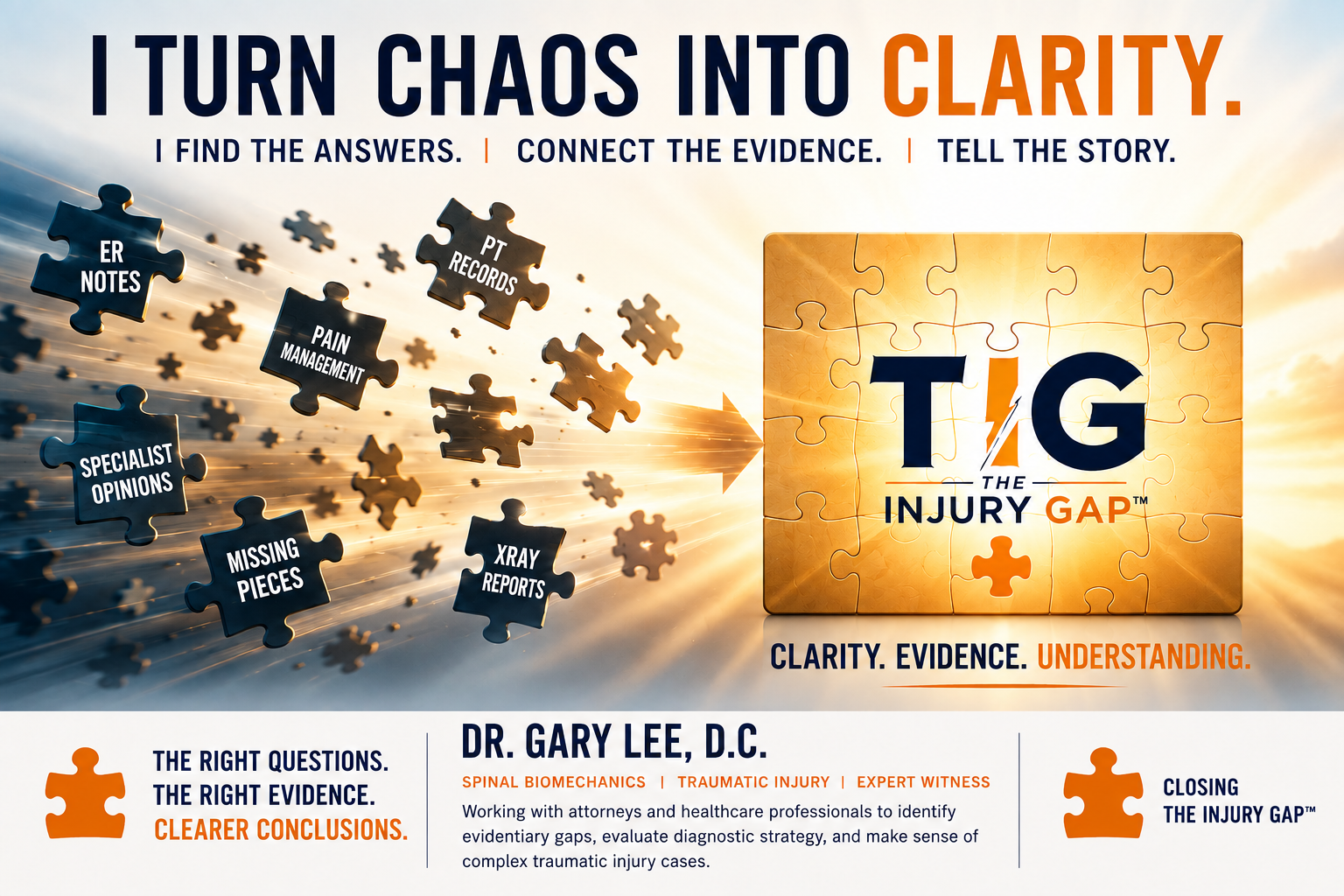
The file was hundreds of pages long.There were emergency department records, chiropractic notes, physical therapy reports, X-rays, MRIs, specialist consultations, pain management records, and months of documented complaints. The patient had been evaluated repeatedly. Treatment had been extensive. On paper, it looked like a thoroughly developed injury case.
But there was a problem. Nobody could clearly explain why this person was still injured. The attorney believed the injuries were significant. The patient knew what had changed. The treating providers had documented legitimate findings throughout care. Yet when I reviewed the records as an expert witness, the medical story didn't lead to a clear conclusion.
There wasn't necessarily a shortage of evidence. There was a shortage of answers.
More Records Don't Necessarily Create More Clarity
After more than 30 years evaluating traumatic injuries and reviewing nearly 100 cases as an expert witness, I've learned something important about complicated injury cases. When a case becomes difficult, the natural response is often to add more.
Another examination. Another specialist. Another procedure. Another MRI. Another hundred pages of medical records.
Sometimes that's exactly what the patient needs .But I've reviewed cases containing thousands of pages of records where the most important clinical questions were never clearly answered. I've also reviewed much smaller files where a handful of well-chosen diagnostic studies and carefully documented findings made the injury remarkably understandable. The difference wasn't the amount of evidence. It was whether the evidence answered the right questions.
Start With the Question, Not the Test
One of the first things I ask when reviewing a complicated case is deceptively simple: What are we trying to understand? Persistent neurological symptoms raise a question. Symptoms that change with spinal position raise another. Suspected ligament injury or instability requires a different investigation. Persistent post-concussive symptoms create their own questions.
And when someone has undergone months of treatment but isn't progressing as expected, perhaps the most important question becomes: Why aren't they getting better?
The diagnostic strategy should follow the clinical question. Yet that sequence can become reversed. A test is ordered because it is commonly ordered rather than because it is the best study for the unresolved problem. An inconclusive result may then create confusion even though the study may never have been capable of answering the question.
This doesn't necessarily mean anyone did anything wrong. Injury care is fragmented. Emergency physicians, chiropractors, physical therapists, radiologists, pain physicians, neurologists, orthopedic surgeons, and neurosurgeons each see the patient through a different clinical lens.
The gap develops when nobody steps back and asks whether all those perspectives make sense together.
The Right Imaging Can Change the Story
This is particularly important with imaging. More imaging isn't necessarily better imaging.
The right imaging is imaging capable of answering the clinical question.
A conventional MRI can provide extraordinary information about discs, neural structures, soft tissues, stenosis, and other pathology. But not every injury is best understood with the patient lying motionless in a neutral position. Sometimes the unresolved question involves movement. When instability is clinically suspected, appropriately indicated flexion-extension radiographs or other dynamic evaluation may provide information that static imaging cannot. When neurological findings don't correlate with existing imaging, the question may be whether the appropriate region, sequence, position, or pathology has actually been evaluated.
The objective isn't to order exotic testing or accumulate studies. It is to select the appropriate study for the question we're trying to answer. That requires more than knowing what tests exist. It requires knowing why you're ordering them.
Sometimes the Answer Is Already in the File
There is another situation I encounter in expert review that can be even more consequential.
The evidence already exists.
I've reviewed imaging where a structural or biomechanical finding becomes important when considered alongside the patient's symptoms, examination findings, and subsequent clinical course. I've also found seemingly minor observations buried hundreds of pages earlier that take on new significance once later events are known.
No individual provider necessarily had the perspective to see the entire sequence.An expert review does. Looking retrospectively across the complete record allows me to ask whether the mechanism is consistent with the initial complaints, whether those complaints evolved, whether objective findings support them, whether the imaging correlates, whether treatment produced the expected response, and whether function returned.
Suddenly, information that appeared disconnected begins forming a pattern. That is where a collection of medical records begins becoming a coherent body of evidence.
Complex Doesn't Mean Unexplainable
Attorneys sometimes send me difficult cases almost apologetically.
"This one is complicated."
Complexity doesn't concern me. Human beings are complicated. Traumatic injuries are complicated. A patient can have pre-existing degeneration and a new traumatic injury. Cervical pathology and post-concussive symptoms can exist simultaneously. Someone can improve in one area while remaining significantly impaired in another. Complexity isn't the problem. Unanswered complexity is.
When I review a difficult case, I don't begin by searching for something dramatic that everyone else missed. I begin with fundamental questions. What happened? What changed after the collision? What objective evidence supports that change? Does the imaging correlate with the symptoms and examination? Why hasn't the patient recovered as expected? What are they continuing to do under duress? What have they lost the enjoyment of doing? What remains unresolved?
Those questions reveal where the gaps actually are. Sometimes another evaluation is warranted. Sometimes a specialist's opinion is needed. Sometimes different imaging should be considered. Sometimes an existing study deserves closer analysis.
And sometimes the answer everyone has been looking for is already sitting in the medical record.
This Is Where My Work Has Changed
For much of my career, I viewed traumatic injury primarily through the eyes of a treating physician. Expert witness work changed that perspective. Reviewing nearly 100 cases has allowed me to examine years of care retrospectively and ask which decisions ultimately clarified an injury—and which important questions remained unanswered.
That experience increasingly defines my consulting work today. Attorneys and healthcare professionals don't always need someone to create more evidence.
Sometimes they need someone who understands traumatic injury, spinal biomechanics, diagnostic imaging, clinical documentation, and forensic case analysis to examine what they already have and determine what it actually means.
My job isn't to manufacture a better case. The evidence has to speak for itself.
My role is to determine whether the evidence supports the medical story being told, identify important questions that remain unanswered, and help clarify whether additional evaluation or diagnostic investigation may be appropriate. That distinction matters. The objective should never be to order a test simply because it might strengthen a legal claim.
The objective is to ask the right medical question and obtain appropriate evidence to answer it. When we do that well, the patient benefits first.
Better Evidence Should Lead to Better Medicine
Better documentation isn't valuable simply because someone may eventually read it during litigation. It's valuable because the next doctor needs it.
The pain management physician needs to understand what has been tried and why symptoms persist. The surgeon needs imaging capable of answering the referral question. The rehabilitation provider needs to understand the patient's functional limitations. And ultimately, everyone involved needs to understand how the diagnoses, objective findings, treatment response, Duties Under Duress, Loss of Enjoyment, and prognosis fit together. When those pieces align, the medical record becomes more than documentation of appointments. It becomes a roadmap.
That roadmap can help identify appropriate treatment possibilities, referrals, unresolved diagnostic questions, and future needs while those decisions can still make a difference.
After three decades in traumatic injury care and nearly 100 expert witness cases, I've learned something encouraging: Complex does not mean hopeless.
Sometimes we simply haven't asked the right question yet. Better questions lead to better investigation. Better investigation leads to better evidence. Better evidence supports better clinical decisions. And better clinical decisions give injured people the best opportunity to understand what happened, receive appropriate care, and make informed decisions about their future.
That is increasingly where I believe I can make the greatest contribution. Finding the unanswered questions. Identifying the evidence that matters. Helping determine the appropriate diagnostic direction. And turning complicated medical records into an injury story that physicians, attorneys, and patients can understand.
Sometimes the difference between an injury that remains confusing and one that finally makes sense isn't another thousand pages of medical records. It's knowing what to look for. And knowing what question to ask next.
That's how we close The Injury Gap™.
About Dr. Gary Lee
Dr. Gary Lee is a chiropractic physician, spinal biomechanics specialist, forensic injury consultant, and expert witness with more than 30 years of experience evaluating traumatic injuries. Through decades of clinical practice and nearly 100 expert witness case reviews, his work has focused on understanding complex traumatic injuries through biomechanics, advanced imaging, functional assessment, and evidence synthesis.
Dr. Lee is the creator of The Injury Gap™, a framework examining the difference between the injury a person actually sustains and the injury that is ultimately recognized, measured, documented, connected, explained, and understood.
His work focuses on asking better questions, identifying important evidence, connecting complex medical findings, and translating that evidence into a clearer understanding of injury, recovery, functional consequences, and prognosis.
Spinal Biomechanics | Traumatic Injury | Forensic Injury Consultant | Expert Witness