A diagnosis can name the injury without explaining what it changed, why recovery stalled, or what the findings mean when the whole case is considered.
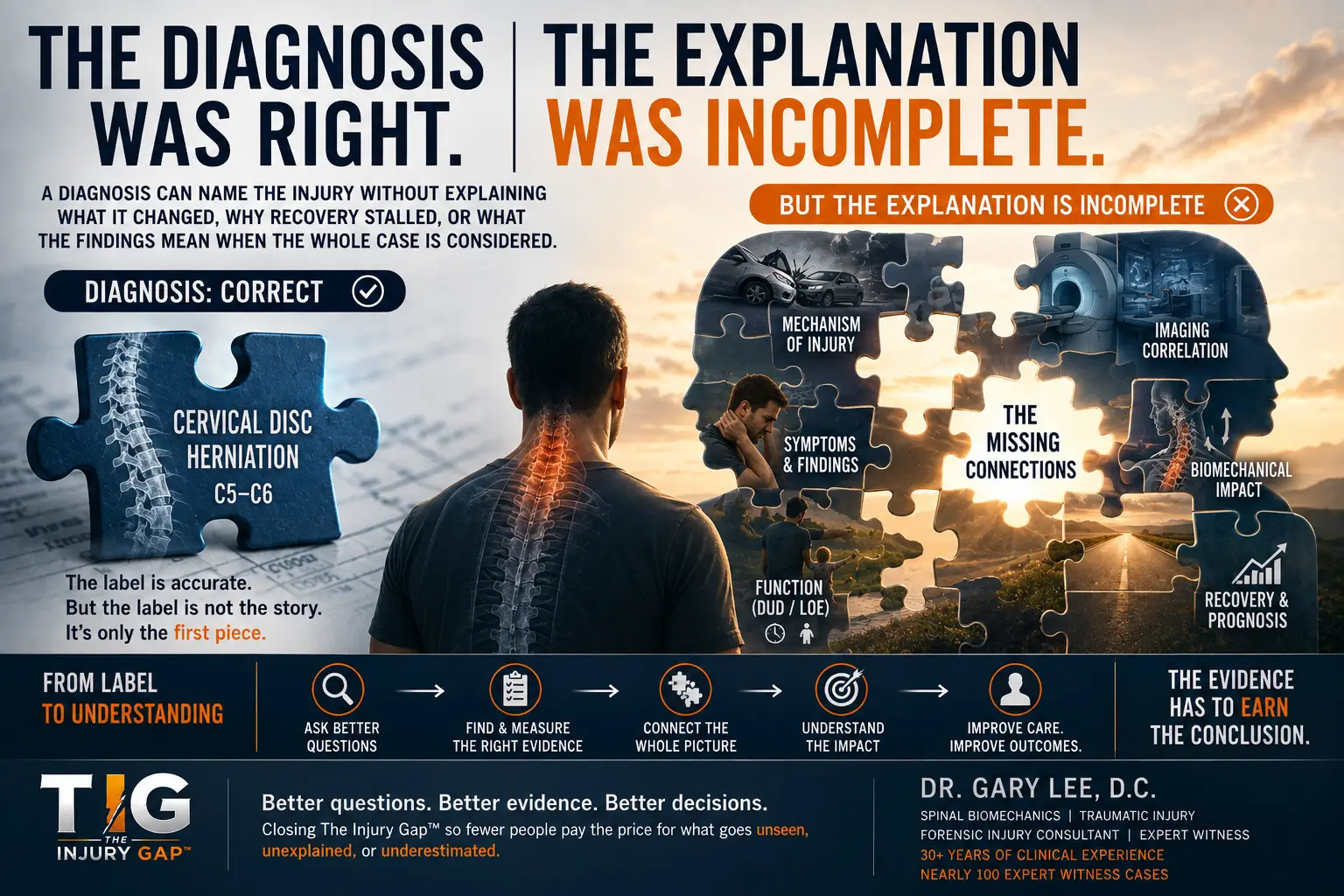
The diagnosis was sitting in the medical record from the beginning.No one had missed it.The radiologist had described the finding. The treating physician had documented the diagnosis. The patient had been referred for treatment, and everyone involved understood that an injury had occurred.
Years later, however, the case was still difficult to understand. The diagnosis was right. The explanation was wrong—or, more accurately, it was incomplete. That distinction has become increasingly important to me after more than three decades of treating injured patients and reviewing nearly one hundred expert witness cases. We tend to think of a diagnosis as an answer. Sometimes it is only the beginning of the question.
A Diagnosis Is an Answer—But Not the Whole Answer
Medicine depends on diagnoses.
Cervical sprain. Disc herniation. Radiculopathy. Concussion. Fracture. Ligament injury. Those labels matter.
They allow physicians to communicate with one another. They help guide treatment. They provide structure to what might otherwise be a confusing collection of symptoms and findings.
But a diagnostic label cannot, by itself, tell us what happened to the person. It doesn't necessarily explain how the injury occurred. It doesn't tell us whether a finding fits the mechanism of trauma. It doesn't automatically explain why symptoms persisted, whether biomechanics changed, why one treatment helped while another failed, or why someone who was functioning normally before a collision still hasn't returned to the same life months or years later.
Most importantly, it doesn't tell us what the injury did.
The diagnosis may be completely accurate while the injury remains poorly understood. I've encountered this repeatedly in complex injury cases. The record contains the right words. The problem is that the words never become a story.
Consider a patient diagnosed with a cervical disc injury following a motor vehicle collision. The MRI documents the abnormality. The diagnosis appears repeatedly throughout the chart. Treatment continues for months. Perhaps the patient eventually receives injections, sees a specialist, or even undergoes surgery. From a documentation standpoint, the diagnosis is difficult to miss.
But important questions may still remain unanswered.
Does the imaging finding correlate with the patient's symptoms? Is there neurological involvement? Does the mechanism of the collision reasonably relate to the injury being discussed? Were there pre-existing findings, and if so, what changed after the collision? Did the trauma affect the mechanics or stability of the injured region? What happened to the patient's function? Why did conservative treatment succeed, fail, or provide only temporary relief? Why hasn't recovery followed the expected course?
And perhaps most importantly: What does all of this evidence mean when considered together?
Those questions cannot be answered simply by repeating the diagnosis.
They require correlation.
The Record Can Be Right and Still Be Incomplete
This is where injury evaluation becomes more complicated.
Mechanism has to be considered alongside anatomy. Imaging has to be considered alongside examination findings. Symptoms have to be considered alongside objective evidence. Treatment response has to be considered alongside the patient's recovery trajectory. Function has to be considered alongside what the patient says they can still do.
No single piece necessarily tells the entire story. Understanding comes from determining whether the pieces fit. That is why I have become cautious when I hear someone say, “We already know the diagnosis.” Knowing the diagnosis is important. But do we understand the injury? There is a meaningful difference.
A diagnosis identifies a condition. An explanation connects that condition to the person. An explanation asks what the finding means in this patient, following this event, with these symptoms, these objective findings, this treatment history, and these functional consequences. That distinction becomes especially important when medical records grow large. A thick file can create the impression that an injury has been thoroughly explained simply because it has been thoroughly documented. But those are not the same thing. Volume is not synthesis. A thousand pages of medical records can contain an extraordinary amount of accurate information and still leave the most fundamental question unanswered: What actually happened to this person?
The emergency physician may have documented the initial trauma. The radiologist may have accurately interpreted the MRI. The treating provider may have recorded symptoms and diagnoses. A specialist may have focused appropriately on one anatomical problem. A therapist may have documented progress during rehabilitation.
Every provider may have contributed something valuable. Yet nobody may have been responsible for stepping back and asking how all of those pieces relate to one another. That is where information can become abundant while understanding remains surprisingly limited.
Where The Injury Gap™ Develops
Sometimes the missing piece truly is diagnostic. Sometimes an important question was never investigated. Sometimes the available study wasn't designed to answer the clinical question being asked. Sometimes the evidence exists but was never measured. Sometimes the findings were documented but never correlated. Sometimes the structural injury is well described while the functional consequences are almost absent from the record. And sometimes every major piece is present, but no one has stepped back far enough to connect them.
This is one of the places where The Injury Gap™ develops.
The Injury Gap isn't limited to injuries that were completely missed. It can exist even when the diagnosis is correct. It develops when identification is mistaken for understanding—when naming the injury becomes the endpoint rather than the beginning of determining what the injury actually means. That distinction matters because patients don't live inside diagnostic codes. They live inside the consequences.
They live with the neck that no longer turns the same way, the workday that now requires modifications, the activity they continue performing despite the pain it creates afterward, or the recreation they quietly stopped doing because they no longer have enough physical capacity left after meeting the obligations they cannot avoid.
A diagnosis may describe pathology. It may say very little about the life built around it.
The Evidence Has to Earn the Conclusion
The Question That Changes the Investigation
After reviewing enough complex injury cases, I've come to believe that one of the most useful questions we can ask isn't simply: “What is the diagnosis?” It is: “What does the diagnosis explain—and what does it leave unanswered?”
That question changes the investigation. It changes the way we read imaging. It changes the way we evaluate biomechanics. It changes the way we think about function. It changes the way we interpret treatment response and recovery.
And it forces us to move beyond collecting medical facts toward understanding how those facts fit together.
A diagnosis can be right without being complete. An imaging finding can be real without establishing causation by itself. A treatment plan can be appropriate without explaining why recovery remains incomplete. A patient can continue working without having returned to normal function.
And every individual record in a medical file can be accurate while the complete story remains surprisingly difficult to see.
That's why I no longer view diagnosis as the finish line. It is one important piece of a much larger investigation. The diagnosis was right. But the diagnosis was never supposed to be the whole story.
Closing The Injury Gap™ begins when we stop treating the name of an injury as the end of the investigation—and start asking what the evidence actually means.
About Dr. Gary Lee
Dr. Gary Lee is a chiropractic physician, spinal biomechanics specialist, forensic injury consultant, and expert witness with more than 30 years of experience evaluating traumatic injuries. Through decades of clinical practice and nearly 100 expert witness case reviews, his work has focused on understanding complex traumatic injuries through biomechanics, advanced imaging, functional assessment, and evidence synthesis.
Dr. Lee is the creator of The Injury Gap™, a framework examining the difference between the injury a person actually sustains and the injury that is ultimately recognized, measured, documented, connected, explained, and understood.
His work focuses on asking better questions, identifying important evidence, connecting complex medical findings, and translating that evidence into a clearer understanding of injury, recovery, functional consequences, and prognosis.
Spinal Biomechanics | Traumatic Injury | Forensic Injury Consultant | Expert Witness
Type your paragraph here